

What Is the Benner Chart (and Why Bitcoiners Should Care)?
Why the next six years may matter more than the last six months

WARNING: THIS IS NOT FINANCIAL ADVICE AND YOU SHOULD NOT USE THIS INFORMATION SOLEY TO MAKE A BUYING OR SELL DECISION!!!!!
Executive Summary (TL;DR for skimmers)
2026 is a classic late-cycle year under the Benner model: high optimism, elevated prices, and rising downside risk.
2027–2029 likely represent a prolonged digestion phase: volatility, drawdowns, boredom, and selective opportunity.
2030–2032 increasingly resemble reset and accumulation years, not euphoric blow-offs.
Price upside does not disappear — but returns become uneven and psychology matters more than narratives.
This is not a “Bitcoin is over” thesis.
It is a “Bitcoin changes tempo” thesis.
Quote of the Day
“Markets don’t end when everyone agrees — they end when no one is paying attention.” - The Inspirator
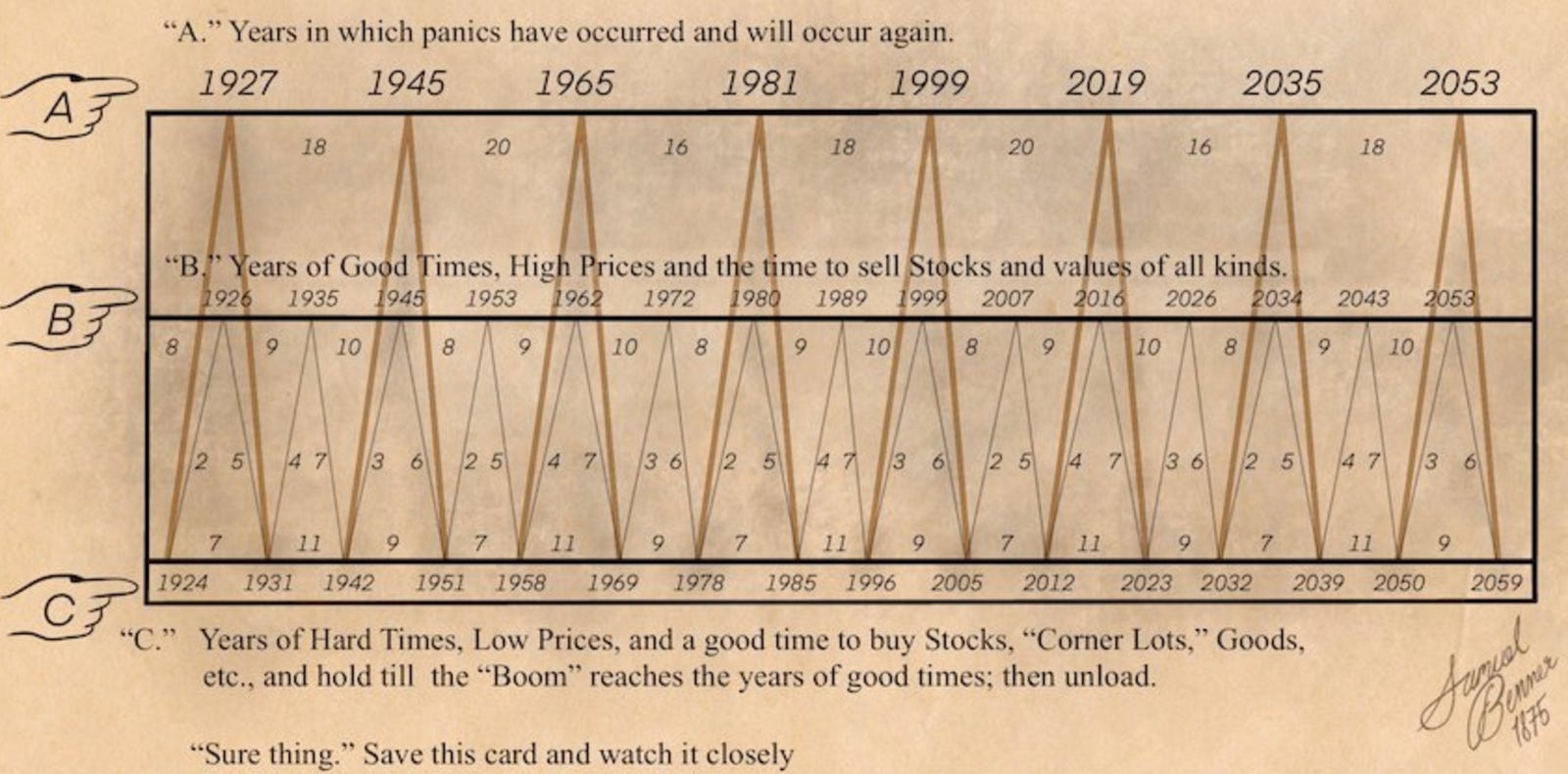
What Is the Benner Chart (and Why Bitcoiners Should Care)?
The Benner Chart is an old market map, created in 1875 by Samuel Benner.
It doesn’t predict prices. It tracks how people behave with money.
Benner noticed that markets move in repeating waves:
People get excited and prices go up
Everyone feels confident
Then something breaks
People panic and sell
Markets go quiet
And the cycle starts again
He grouped these waves into three simple phases:
Good Times: Prices are high, news is positive, and everyone feels safe.
Hard Times: Prices stall or fall, markets are boring, and people lose interest.
Panic Times: Fear takes over, prices drop fast, and most people give up.
Bitcoin is new — but human behavior is not.
Even though the Benner Chart is over 100 years old, Bitcoin has followed these same emotional patterns:
Big excitement near tops
Long, boring stretches afterward
Scary sell-offs that feel like the end
Quiet years where patient investors build positions
The Benner Chart doesn’t tell us what Bitcoin will do next week.
It helps us understand what kind of year we’re in — and that matters, because doing the right thing in the wrong year often feels wrong.
That’s why the sections below don’t focus on hype or exact prices.
They focus on cycle awareness, risk, and patience — the things that actually matter over time.
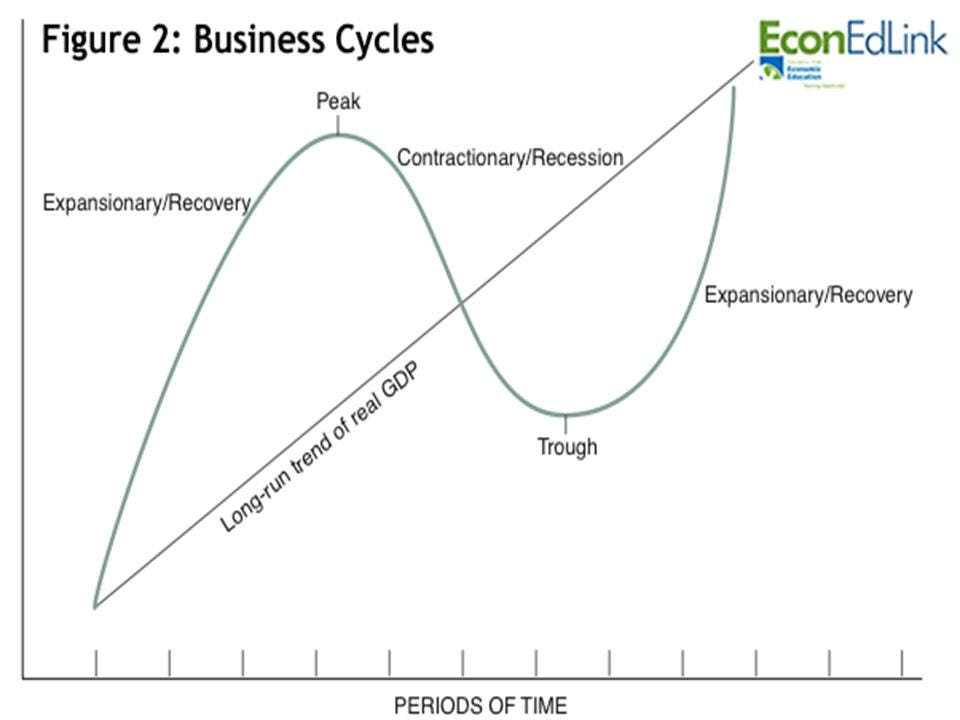
The Three Parts of the Benner Cycle
Benner said markets rotate through three moods:
🟢 Good Times
This is when:
Prices are high
Everyone is confident
The news is positive
People say, “This time is different”
These years often feel safe — but they are usually the riskiest.
🟡 Hard Times
This is when:
Prices stop going up
Markets move sideways or down
Fewer people care
The excitement disappears
Nothing dramatic happens — and that’s the problem.
Most people quit paying attention here.
🔴 Panic Times
This is when:
Something breaks
Fear takes over
Prices drop fast
People sell because they’re scared
These moments feel terrible —
but they are often when big opportunities quietly appear.
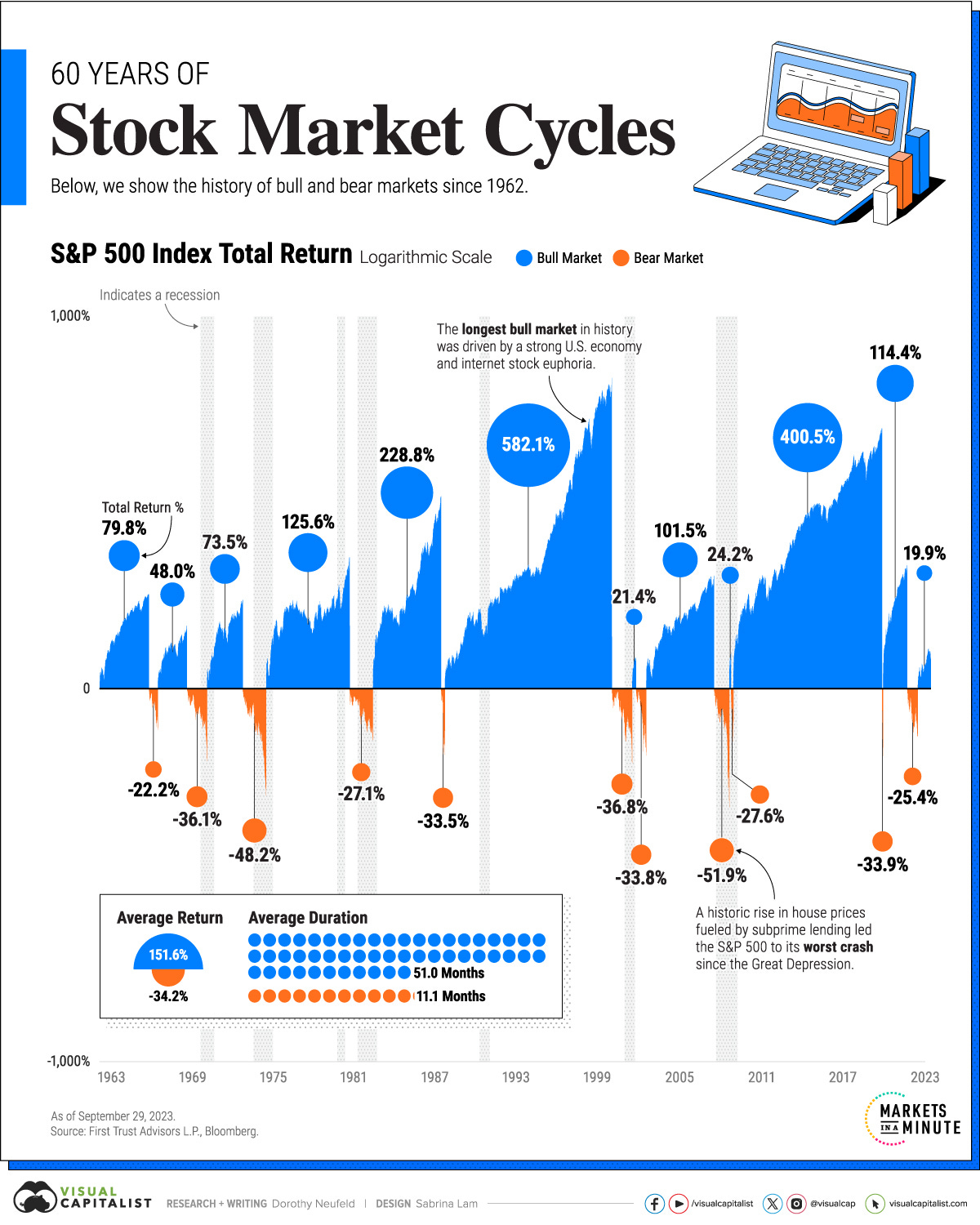
Why This Matters for Bitcoin
Bitcoin is new.
Human behavior is not.
Even though Benner made this chart over 100 years ago,
Bitcoin has followed these same emotional waves:
Big excitement at the top
Long boring periods after
Panic moments everyone regrets selling into
And quiet years where smart money builds positions
The Benner Chart doesn’t tell us where Bitcoin will go tomorrow.
It helps us understand what kind of year we’re in.
And that matters — because doing the right thing in the wrong year feels wrong.
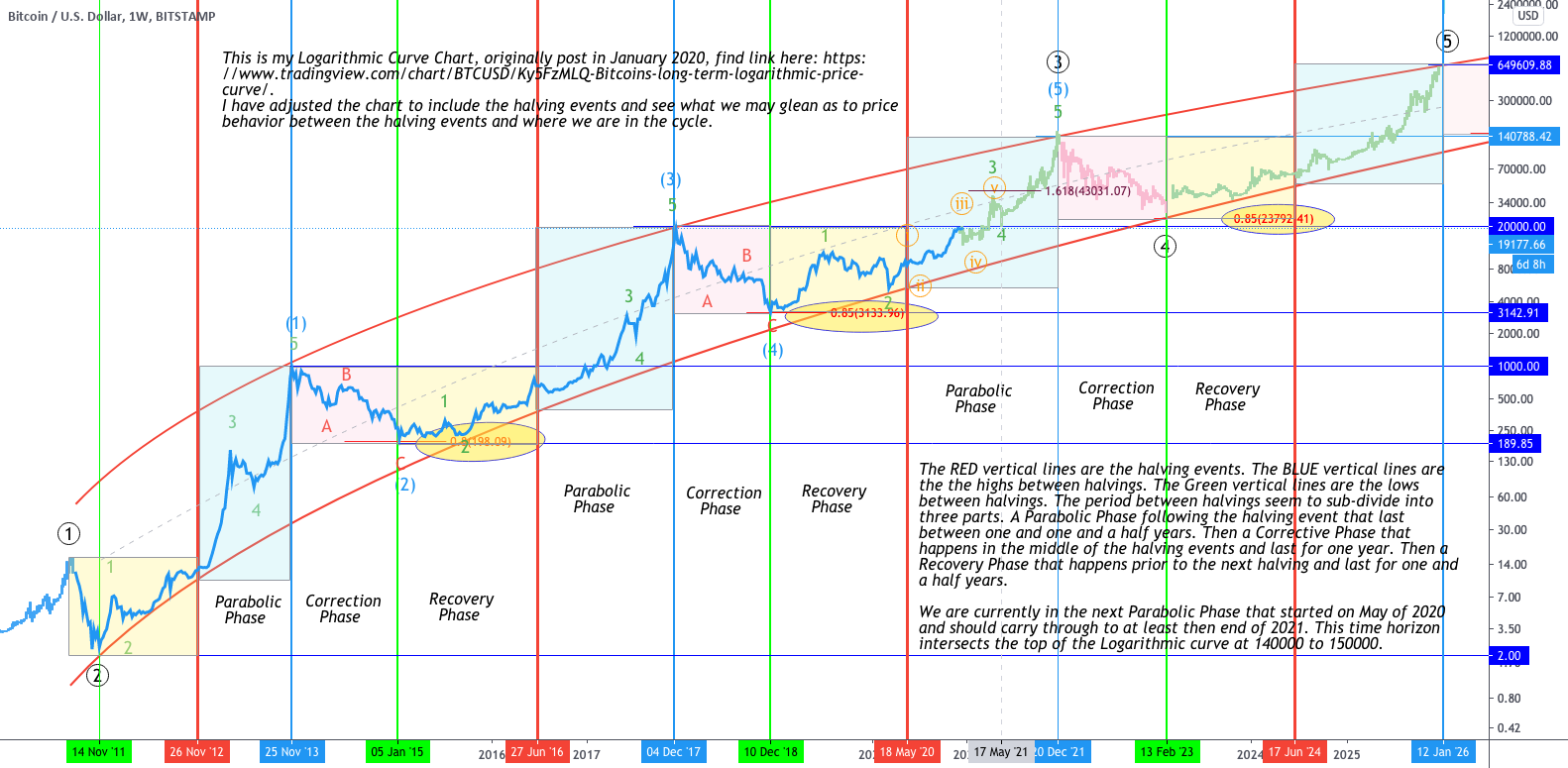
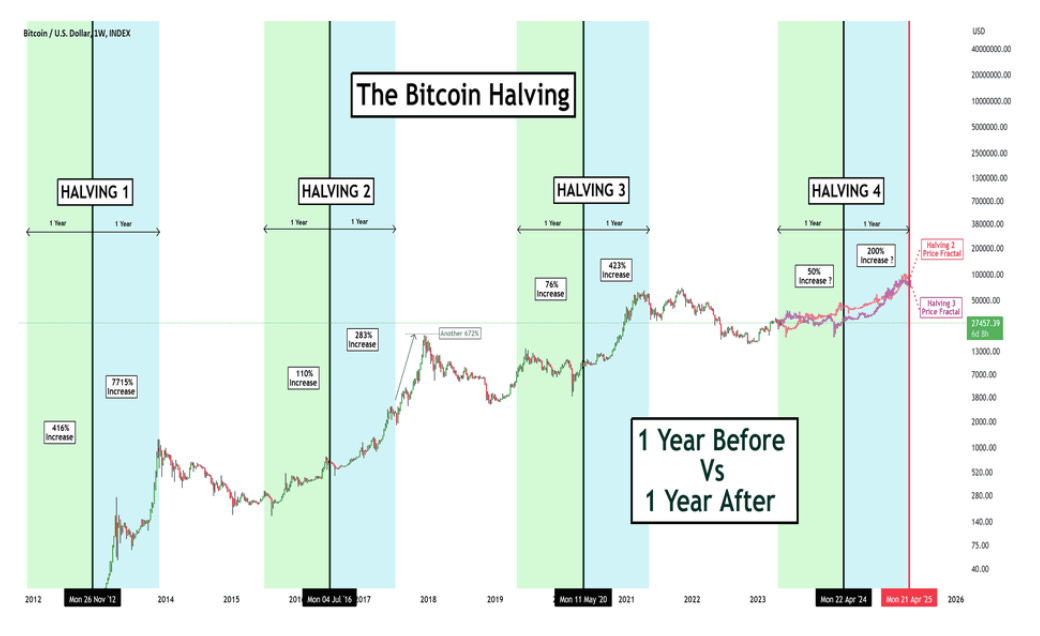
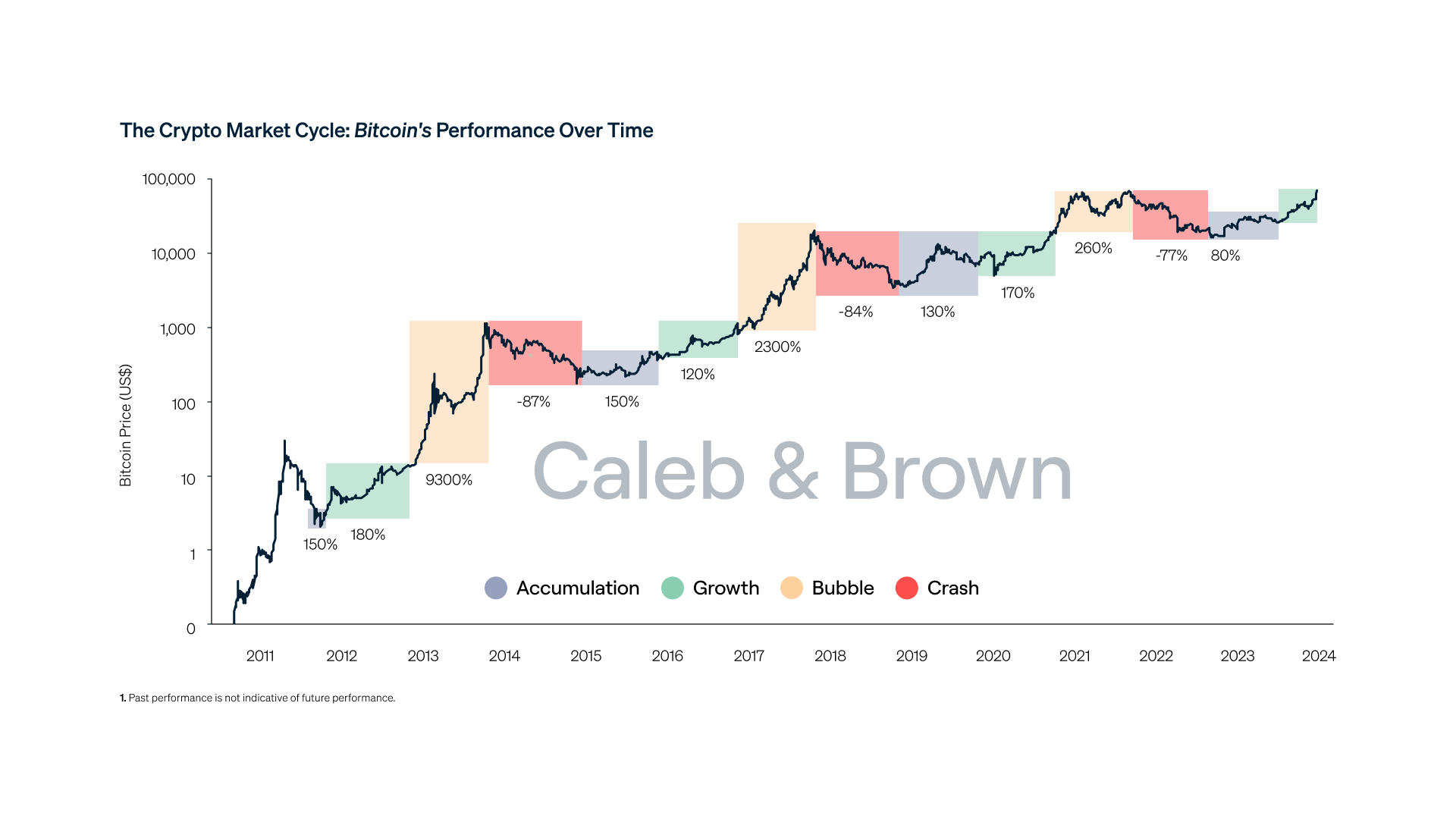
Overlaying Benner with Bitcoin: 2026–2032
2026 — Late Bull / Distribution Risk
Benner Phase: Good Times (B)
Market Character:
Elevated valuations
Strong narratives (ETFs, institutional adoption, treasuries)
Rising leverage and volatility
Bitcoin Reality:
This is not early-cycle Bitcoin. This is post-halving, post-ETF Bitcoin.
Historically, this phase is where:
New highs are possible
Risk becomes asymmetric
Late buyers confuse momentum with safety
Probable Price Range (2026):
Bear case: $70k–$85k
Base case: $90k–$130k
Bull case: $150k–$180k
Probability-weighted expectation favors volatility and distribution, not straight-line gains.
2027 — Digestion & Drawdown
Benner Phase: Transition toward Hard Times
Market Character:
Narrative fatigue
Reduced liquidity
“Bitcoin is broken again” discourse
Bitcoin Reality:
Every prior cycle had a year like this.
Probable Price Range (2027):
Bear case: $45k–$60k
Base case: $60k–$85k
Bull case: $100k (failed retests likely)
This is typically a psychologically brutal year, even if structurally healthy.
2028 — Tension Year (Benner vs Halving)
Benner Phase: Hard Times
Bitcoin Event: Halving year
This is where models conflict.
Benner suggests caution
Bitcoin’s supply mechanics improve
What usually happens:
Sideways-to-up bias
Violent shakeouts
Accumulation disguised as boredom
Probable Price Range (2028):
Bear case: $55k–$70k
Base case: $70k–$100k
Bull case: $120k
2029 — Expansion Attempt
Benner Phase: Hard Times
Bitcoin Reality: Post-halving momentum tries to assert itself
This year determines whether Bitcoin:
Breaks decisively higher
Or remains capped by macro liquidity constraints
Probable Price Range (2029):
Bear case: $65k–$85k
Base case: $90k–$140k
Bull case: $180k–$220k
High dispersion. Expect disagreement. Expect volatility.
2030 — Fragility or Continuation
Benner Phase: Hard Times
If 2029 ran hard, 2030 often disappoints.
If 2029 stalled, 2030 can surprise.
Probable Price Range (2030):
Bear case: $60k–$80k
Base case: $80k–$120k
Bull case: $160k
2031–2032 — Reset & Re-Accumulation
Benner Phase: Hard Times (explicitly low-price favorable years)
These are typically:
Quiet years
Low engagement years
Builder and allocator years
Historically, this is when future winners are positioned.
Probable Price Range (2031–2032):
Bear case: $50k–$70k
Base case: $70k–$100k
Bull case: $120k–$150k
This period increasingly sets up the next major Bitcoin expansion beyond 2032–2034.
Question of the Day
If Bitcoin traded sideways for five years but doubled afterward, would you still hold — or would boredom beat conviction?
The Big Idea
Markets don’t fool people with math.
They fool people with feelings.
The Benner Chart is just a reminder:
If you can stay calm when others are excited
and stay patient when others are bored
you already have an edge.
What This Means for Investors (Plain English)
2026: Manage risk. Do not confuse adoption with inevitability.
2027–2029: Patience beats prediction. Consistency beats conviction.
2030–2032: These are likely remembered as “missed years” by those who quit paying attention.
Bitcoin has never rewarded maximum enthusiasm.
It has always rewarded maximum endurance.